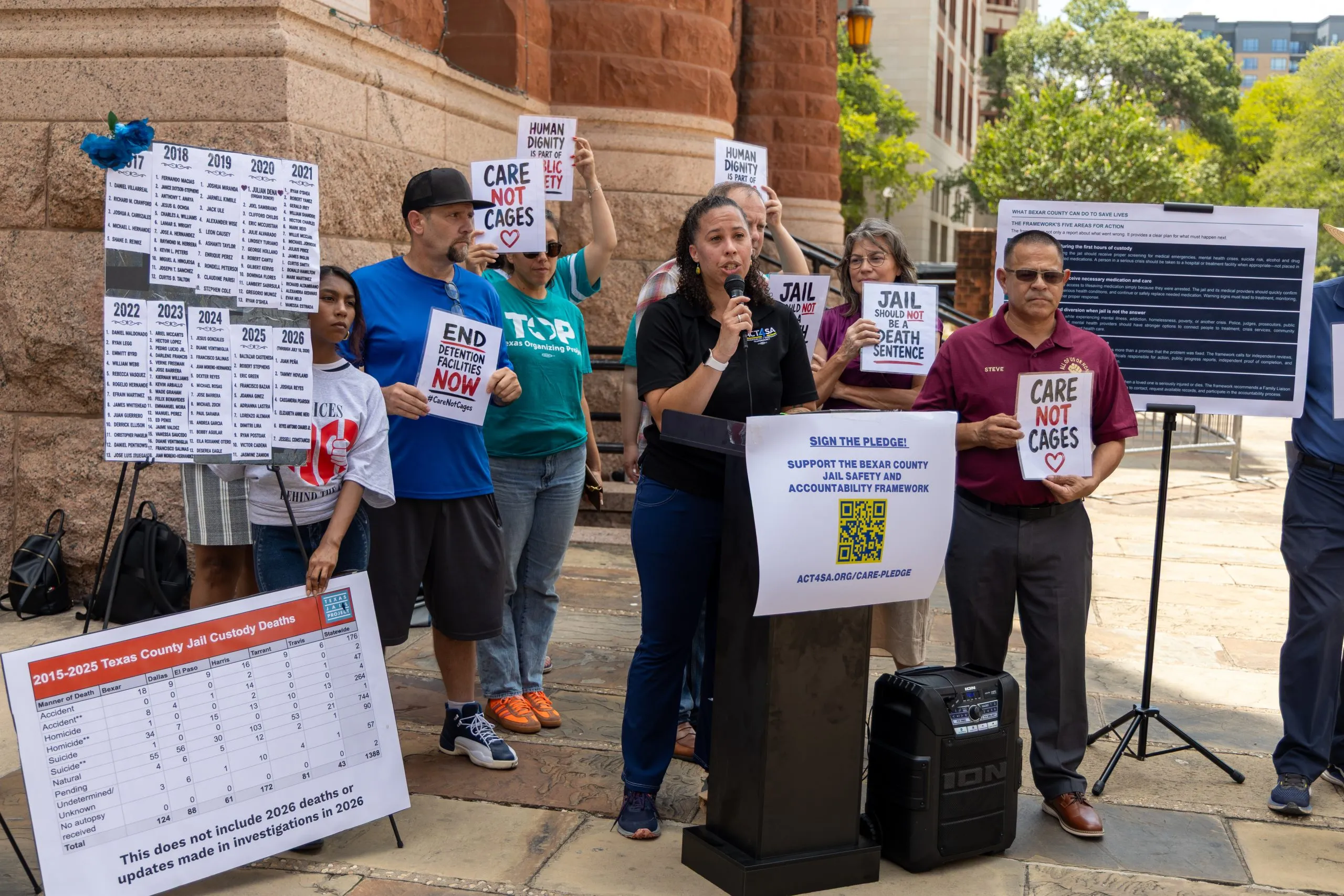
A coalition of advocacy organizations are calling on Bexar County to fundamentally reshape how people move through its jail system, releasing a that urges officials to expand diversion, strengthen medical and mental health care and create new layers of accountability after years of deaths in custody.
Read more What to do after a Public Intoxication arrest in San Antonio
Since January, seven people have died in custody at the jail.
The proposal enters a policy debate county leaders have already spent much of the past year navigating. Officials have advanced many of the same behavioral health and diversion initiatives outlined in the framework, while continuing to grapple with jail overcrowding, in-custody deaths and how best to reduce the number of people entering the criminal justice system.
Standing outside the Bexar County Courthouse on Tuesday, members of All of Us or None Texas, ACT 4 SA and the Texas Jail Project unveiled what they call the Bexar County Continuum of Care, Safety, Accountability, Population Management and Family Rights Framework, a more than they say is intended to shift the county’s approach to criminal justice from incarceration toward treatment, prevention and accountability.
The framework recommends coordinated action across five broad areas: improving medical and mental health screening during booking, strengthening continuity of care, expanding diversion and treatment alternatives, improving communication with families after serious incidents and creating independent oversight of deaths in custody through public reporting and corrective action plans.
“We demand transparency. We demand an understanding of where they are at to bring this crisis under control,” All of Us or None Texas Executive Director Steve Huerta said during Tuesday’s news conference. “We already know what went wrong. What we want to find out is what they’re going to do about it, and if they’re having trouble figuring out what their role is in all this, we laid it out in the framework for them.”
But some of the agencies at the center of the framework say they were never consulted during its development and dispute several of its underlying assertions.
After the news conference, Huerta questioned whether University Health, the county’s health system could quantify the mental health screenings it performs at the jail, arguing the lack of publicly available data reflected broader concerns about accountability.
University Health officials said they first learned of the framework when the San Antonio Report requested comment.
“We were surprised to receive the completed report from a news media outlet yesterday,” a University Health spokesperson said in a statement. “We were not aware that these organizations were developing this document and disappointed that they did not conduct any interviews or ask for any data from the team that provides healthcare services in Bexar County detention health facilities.”
The health system said a preliminary review of the first 16 pages identified multiple inaccuracies describing a lack of program and practices that UH says are already in place, including medication-assisted treatment for opioid use disorder, medically supervised withdrawal protocols, suicide risk assessments, naloxone administration, medication continuity during booking and mental health screenings required under state law.
Officials also provided data showing University Health has completed 14,481 mental health assessments since taking over the Justice Intake and Assessment Annex (JIAA) in October 2025, including 8,282 comprehensive assessments at the Justice Intake Assessment Annex, and has returned 11,697 court-ordered mental health evaluations to magistrates during that period.
A spokesperson for the county added that commissioners had also not received information regarding the framework and declined to comment on its recommendations before members have had an opportunity to review the document.
Much of the framework’s broader vision mirrors work Bexar County officials have already begun pursuing.
Over the past year, Commissioners Court has held work sessions examining everything from jail diversion and behavioral health treatment to expanding inpatient psychiatric capacity and reducing pressure on the county jail. Those discussions have centered on many of the same issues raised in Tuesday’s framework — how to divert more people with mental illness and substance use disorders into treatment, improve coordination between agencies and reduce reliance on incarceration.
During a meeting in April, County Judge Peter Sakai cautioned commissioners there was “no one building, no one program” that would solve the county’s jail challenges, describing diversion as one piece of a broader strategy that also includes policy changes, behavioral health investments and additional facilities.
Commissioners have already acted on some of the issues raised during those work sessions. After commissioners identified a lack of funding for prescription medications at the Applewhite Recovery Campus as a barrier preventing eligible detainees from being transferred into treatment, county officials secured funding to begin moving people out of jail and into the facility.
Meanwhile, the Center for Health Care Services — the region’s mental health authority — continues work on a feasibility study for a regional diversion center that’s expected to inform the 2027 budget discussions for the city and county.
The proposed diversion center would provide a short-term alternative to jail for eligible people experiencing mental health crises or substance use disorders before connecting them with ongoing treatment.
But officials have also acknowledged that expanding diversion programs will require difficult budget decisions.
Many of the county’s behavioral health and diversion initiatives were launched with federal American Rescue Plan Act dollars or opioid settlement funding, both of which are temporary. During previous budget discussions, county officials acknowledged they are still evaluating how those programs will be sustained as the roughly $389 million in federal pandemic relief dollars expire.
A program offering methadone treatment — a medication that treats opioid addiction — was shuttered earlier this year alongside position cuts at CHCS due to expiring pandemic era federal funding.
In April, County Manager David Smith told commissioners the county was headed for its weakest property tax growth since the 2008 financial crisis.
Asked how commissioners should pay for the framework’s recommendations with looming budget discussions scheduled to start in the coming months ACT 4 SA Executive Director Ananda Tomas said the county should reprioritize existing spending inside the jail rather than create new revenue.
“We’re not getting results, you guys have the power of the purse,” she said. “Move some money into these other programs instead of continuing to funnel money into systems and departments that are not being accountable and not putting it to good use.”
The debate is expected to continue in early August. Commissioners earlier this month postponed a planned workshop on jail population, diversion strategies, behavioral health services and long-term jail planning until Aug. 4, where officials are expected to revisit many of the same issues raised in the framework, including diversion, treatment capacity and the future direction of the county’s criminal justice system.
Read more San Antonio’s ‘Face the Fight’ coalition expands national efforts to save military veterans’ lives