
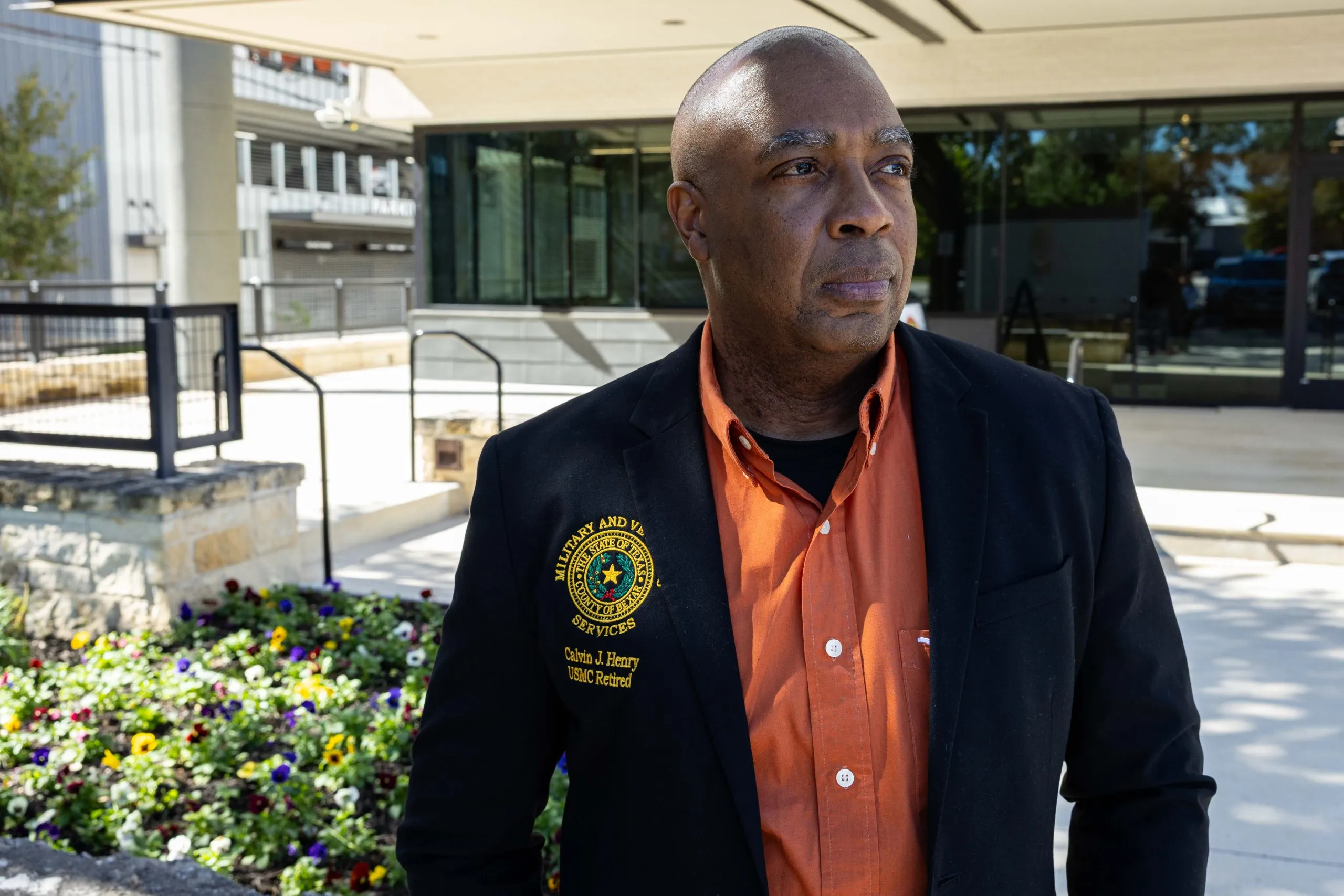
Following a tumultuous period at Bexar County’s Department of Military and Veterans Services, a new director has been appointed: retired U.S. Marine Corps Chief Warrant Officer 2 Calvin Henry.
Read more Meet Bexar County’s new director of military and veterans’ services
Henry served in the Marine Corps for 20 years, and has been serving as the interim director since March. Prior to his appointment, he worked for Bexar County as its Military Service Officer and Benefits Manager.
The previous director, Keith Wilson, was terminated after scrutiny over allegations that he was frequently absent and failed to address misconduct by his deputy director who was fired for creating a hostile work environment for employees, including discriminating against veteran employees with service-connected disabilities like PTSD.
Wilson is now suing over his termination. Henry says he is looking to move on from the period of instability at the department and focus on the mission: connecting veterans to their benefits, assisting with the claims process and helping with employment and transition from active duty.
This interview has been edited for clarity and length.
What drew you to this opportunity?
I was a retired Marine, with 20 years of leadership. I also worked in the private sector in education, and with the state at the comptroller. But my passion for veterans and working with veterans is where I first started. I’ve been with the county for five years, working on both sides of the house, employment and transition, employment and the benefits side. So it made me a pretty viable candidate for the position I’m currently in.
What are you proud of accomplishing so far?
What I’m proud to accomplish and still working towards is the cohesiveness of our department. It’s no secret, we’ve been through some things. Keeping the department focused and reinstalling the trust of the position, the trust of the actual billet, so to speak. That’s what I’m extremely proud of.
Your predecessor had this job for four years, and then left with other staff turnover. How are you guiding the department past that period and restoring public trust in your services?
What we’re doing is going back to the basics, working with the, for lack of a better word, our customer, which is our veterans. Reinstalling trust, letting them know that they’re still our forefront. We’re doing it by meeting them where they are, making sure that no one is left behind. But most importantly, that them and their families are important. They are why were are here.
Read more NEISD board approves closing 3 elementary schools to cut budget deficit
The past two years have seen a lot of change for the city’s military sector. Is your office involved in any way in bringing new initiatives to San Antonio to help keep the military sector alive?
Indirectly, I would say yes, because I’m working with [retired Maj. Gen Scott Jackson] on some initiatives. The county and city never, from my understanding, didn’t work as much in the cohesive way that Scott and I are planning and continue to do. So, with him taking most of the lead on the infrastructure of the city, I’m helping where I can fit in. Even if it’s just support. But he and I are working on some stuff together.
For example the BAMC issue. He handles buildings, I handle people, he handles policies, I handle benefits, kind of like that. So ensuring that any word or anything that’s passed down in any meetings that I’m privileged to have with Scott or the players in that realm, I can funnel that to the veteran and maybe take away some of that stigma of what’s going on. So helping dispel some of that rumor, but more importantly, being transparent and letting them know, hey, we’re growing this together.
What was your own experience in the military and transition out of the military like? Are there resources that you wish you had at the time that you are working to connect veterans with now?
Just like any other veteran it was the unknown. You go from being the uniform, and that’s your identity, to Calvin. That was probably my biggest obstacle, understanding that dynamic. But once I got to Texas, being a Texas resident, I already knew some of the benefits. But not having a VSO per se, like with our office, where you connect with someone here and that person walks you through the transition or benefits. I did it on my own, so if I had to do anything over, I wish I could have had what veterans have now with us. We work a lot of with referrals, especially with veterans that are retiring to here from other bases, even outside the country. They give us an email. ‘Hey, I’m retiring in this area. I would like to have someone to help us.’ So that really didn’t exist much. If it did, I didn’t know.
What challenges have you found the military and veteran populations here to be facing, and how are you working to address them?
It’s getting the knowledge out. It’s inevitable that either myself or one of my department team members run into a veteran who didn’t know we exist. So getting the word out, I think that’s the biggest challenge, obstacle, and issue. Veterans don’t know what they don’t know, and more importantly, the family members don’t know. We address that by having workshops in each one of the precincts, all four precincts of the county, but also working with the military advisory of the city, [Veterans Advisory Commission, representing the mayor and] the 10 districts. So we’re starting to have some workshops in those areas.
What is unique about the Bexar County veteran population?
We are very unique. We have everything from the Vietnam, all the way to the guys that are just getting out. We have a large female veteran population that has always been there. Now they are getting noticed. We have on my staff Miss Marsha Covington, who’s my benefits manager, and she’s really enthralled with [Military Sexual Trauma] because MST before it was just something they looked at as a female veteran problem. It is a veteran problem, regardless. She handles a lot of that. As far as the older veterans, we attend the Edgewood breakfast every week. We hear a lot from them. A lot of my staff speaks Spanish, so we ensure that part is taken care of as well. We’re continuously training. We’re continuously learning, and that makes us who we are.
Diego Medel contributed to this report
The San Antonio Report’s military and veterans coverage is supported by Report for America.
Read more What San Antonio healthcare leaders want from lawmakers in 2027