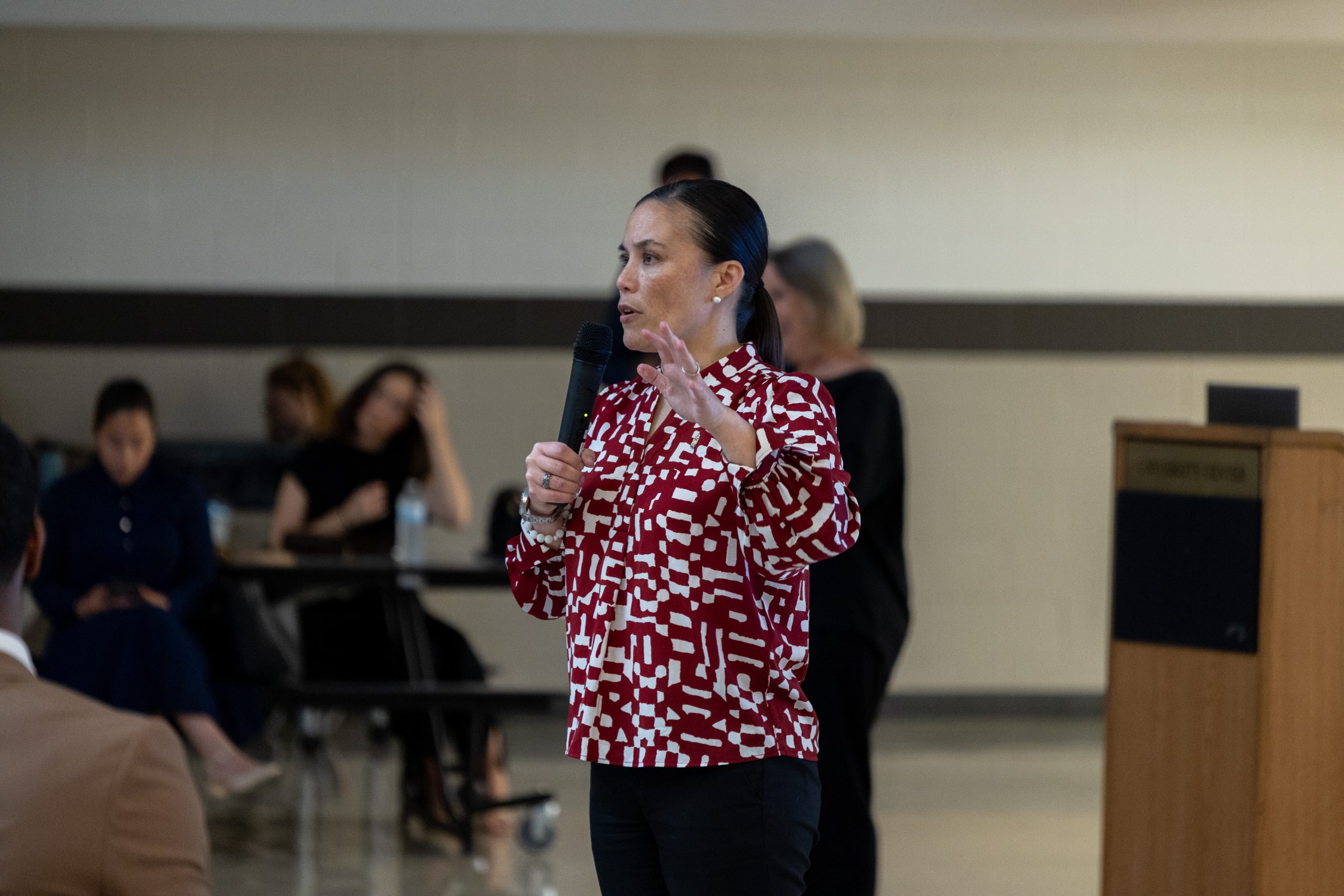
With San Antonio staring down a $158 million budget deficit, Mayor Gina Ortiz Jones devoted much of a town hall Wednesday night to preparing residents for difficult financial decisions ahead — including defending her proposal to ask voters to end the city’s Ready to Work workforce development program early instead of raising property taxes.
Read more Basking in increased visibility, Trinity’s new branding draws from historic sun imagery
Speaking to dozens of District 1residents at Edison High School, Jones argued the city should exhaust every available option before asking taxpayers to pay more, describing a financial outlook she said has worsened in recent weeks.
“We’ve got a $158 million budget gap,” Jones said. “For context, if you closed every library, if you closed all of Animal Care Services, if you took all of the money in the general fund out regarding public health, you’d still have to go find another $20 million.”
Jones said after meeting with City Manager Erik Walsh earlier Wednesday, the proposed budget scheduled for release Aug. 13 is expected to include even deeper cuts than council members had previously anticipated, though she declined to identify which programs could face additional reductions before the proposal is unveiled.
She added that the city’s next bond program — which funds major capital projects like streets, sidewalks, drainage improvements and parks — is now expected to be significantly smaller than originally projected because property values have not grown as anticipated.
“This is how we get after those projects, drainage, in infrastructure projects, parks, etc. In the 2022 bond, we had a $1.2 billion dollar capacity,” she said. “This year, we were expecting ideally something similar, but based on where property values are, we were initially at $600 million. We will now be south of $600 million.”
Jones said the combination of a shrinking bond program and widening budget deficit has forced city leaders to reconsider ideas that may have previously been politically untouchable.
Chief among the ideas she’s pushing is asking voters to allow the city to redirect roughly $100 million remaining in the Ready to Work program. Approved by voters in 2020, the program is funded through a one-eighth-cent sales tax and was created to help residents earn workforce credentials and secure higher-paying jobs after the economic disruption caused by the COVID-19 pandemic.
While state law limits how the remaining sales tax revenue can be spent, Jones said several eligible programs — including literacy promotion, after-school programs and job training initiatives — are currently funded through the city’s general fund. Redirecting Ready to Work dollars to those programs with voters’ approval, she said, would free up general fund money for public safety, street maintenance and drainage projects.
Where council stands on Ready to Work
Jones would need six votes, including her own, to put the question to voters. She would need to find three more “yes” votes ahead of Aug. 17 to meet the November ballot deadline.
Councilmembers Sukh Kaur (D1), Phyllis Viagran (D3), Teri Castillo (D5) and Ivalis Meza Gonzalez (D8) have all said they don’t want to end the Ready to Work program early.
Two conservative voices on the council, Misty Spears (D9) and Marc Whyte (D10), both expressed support for the idea.
Councilmembers Edward Mungia (D4) and Marina Alderete Gavito (D7) have expressed openness to discuss the proposal while Jalen McKee Rodriguez (D2) and Ric Galvan (D6) have not publicly taken a stance.
Speaking to the press after the town hall, Jones said the scale of the deficit requires creative thinking like looking at the Ready to Work budget.
“People are talking about raising garage sale permits. What are we going to raise them to? $25,000 apiece? Let’s be serious,” Jones said. “My priority remains not raising people’s property taxes in this very difficult time. So yeah, we’re going to go through the intellectual exercise.”
Not every community member at Wednesday’s town hall was ready to support ending Ready to Work early.
District 6 resident Elijah Serena said he wants more information before deciding whether redirecting the remaining funds is the right approach.
“I don’t necessarily wholeheartedly agree with it or disagree with it,” Serena said. “I need to see what that funding would be going to if it were to be redirected — where would it go, and in what amounts?”
Serena said he has questioned whether Ready to Work duplicates the workforce training already available through organizations like Alamo Colleges, but said he would need to see evidence that the program isn’t filling a unique role before he’d vote to end it early.
Looking for cuts
Jones also reiterated her recent call for corporations, foundations and philanthropists to help cover the cost of nonprofit organizations that currently receive city funding, arguing taxpayers shouldn’t be asked to pay more before the city seeks private support.
Last month, Jones floated eliminating city funding for nonprofits that charge admission, including the San Antonio Botanical Garden and San Antonio Book Festival.
Wednesday, she doubled down.
“I have yet to meet the person that says, ‘Yes, please raise my property tax so you can give the Botanical Garden a million dollars,’” Jones said, drawing applause from many in the packed cafeteria.
While the budget discussion dominated much of the nearly hour-long town hall, residents also questioned Jones and city department leaders about everything from homelessness, pedestrian safety, Animal Care Services, neighborhood infrastructure projects, data centers and the city’s response to federal immigration enforcement.
The proposed budget is scheduled for release Aug. 13, with City Council expected to spend the coming weeks debating spending cuts, potential revenue increases and whether to place the Ready to Work measure before voters ahead of the Aug. 17 ballot deadline.
Read more Bexar County is already rethinking its jail strategy. Advocates say it’s not enough.