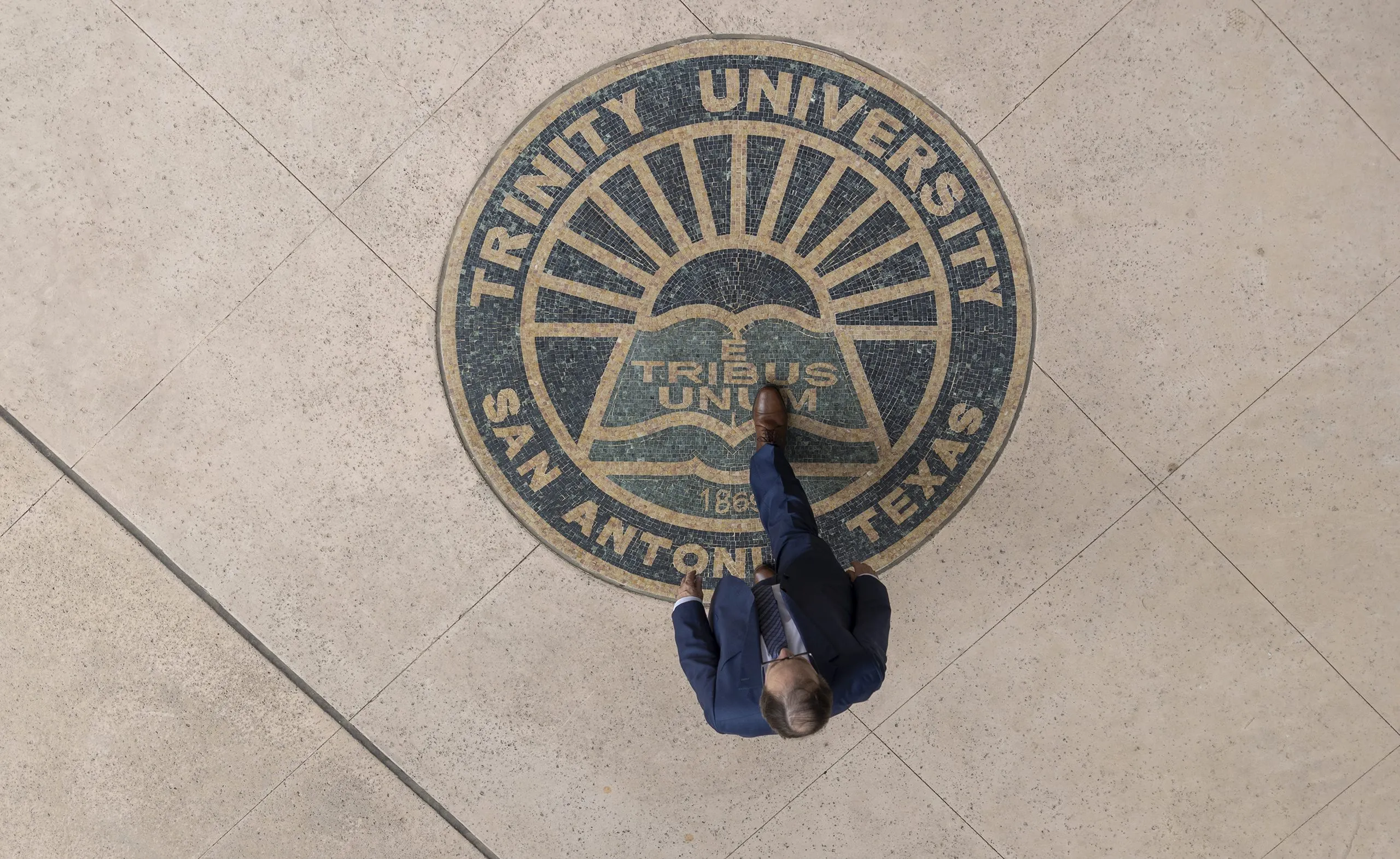
This morning, Trinity University is turning the page on the bell tower logo that represented the university for the last 23 years and bringing back the sun as its renewed emblem, an ode to the rising sun depicted in its official seal created 157 years ago.
This is part of a brand refresh aimed at enhancing the recognition of San Antonio’s “university on a hill,” officials said. But the refresh goes well beyond the new maroon sun logo, Trinity officials explained, with a website redesign and updated messaging to draw a larger audience.
“We are finishing construction on our welcome center and a new event space on our campus. And if we think of that as a gateway to our campus, we also have to think about the website as a gateway,” said Trinity President Vanessa Beasley.
This move comes at a time when the dreaded demographic cliff — a decline in U.S. brith rates that is projected to result in a 7.4% decrease in 18-year old residents between 2026 and 2023 — is impacting the number of college-aged students.
At thesame time, the value of higher education degrees is often in question; there’s perhaps less understanding of the role of a liberal arts institution; and recruiters from further away are flocking to Texas vying for potential students, Beasley explained.
But Beasley and her team say the new branding comes from a place of strength for the university as they continue to see healthy application and enrollment numbers, rising rankings and financial support.
“Trinity is in a really good place in terms of fundraising and enrollment and in reputation,” said Tom Evelyn, vice president of strategic communications and marketing. “We’ve been moving up in the rankings. We’ve had a number of years of record enrollment, record fundraising, three $25 million plus gifts over the last few years. …
“But also, we can’t just sit on our laurels. The competition is growing every day for students.”
Evelyn, joined Trinity about a year ago and led the rebrand effort. The small liberal arts university — which has an enrollment of about 2,800 students and student-faculty ratios of about 9-to-1— has an endowment valued at $2 billion, with interest/earnings that support about 40% of the university’s operations, scholarship funds, faculty support and more.
Trinity is also the only liberal arts and sciences university located in a large metropolitan area, Evelyn said. The website redesign will place San Antonio front and center of the school’s messaging to attract students who are looking for the traditional liberal arts college experience but in a city where they can also engage with a broader community.
To not consider a better way to present what Trinity has to offer to students and families in and outside of Texas, would be a disservice to what the state offers and to the options these students get to consider, Beasley said.
“[Recruiters] know [this is] where the students are, where the talent is. Frankly, [this is] where the energy is,” Beasley said. “So we would be betraying our own roots and our love for the community if we abandon that.”
Nationally ranked
In 2021, just as Beasley joined Trinity as its 20th president, the university went from being classified as a regional institution to a national one. At the time, its Carnegie Classification — based on the types of degrees granted, size and field of study — jumped from a Master’s College to a BaccalaureateCollege.
Today the university ranksNo. 37 out of 207 national liberal arts colleges in the US News and World Report rankings, No. 51among private colleges across in the nation and No. 19 among colleges in the South by Forbes.
These national rankings have translated into more visibility for the university, Beasley said.
“Our name is showing up in places that it hasn’t been before,” Beasley said. “ And we’re finding that there’s more traffic to the website. There are more people saying, “You know, I never heard of Trinity University in Texas. I want to know more about it.’”
Read more Bexar County is already rethinking its jail strategy. Advocates say it’s not enough.
Since 2021, the number of new student applications at Trinity University has increased. Officials reported receiving 9,626 applications for enrollment in 2021.
By 2024 that number rose to 12,507, then fell slightly to 11,927 applicants in 2025, with 11,657 applications so far this summer for 2026 enrollment.
So far this summer, 28% of applicants have gotten accepted into Trinity for the 2026-27 academic year, compared to a 34% acceptance rate in 2021.
“The university is much different from 10 or 11 years ago,” Clinton Colmenares, senior director of news and media strategy at Trinity said in a statement. “The growth is due to more effective marketing, population growth and demographic shifts in Texas, and more strategic recruitment to attract more students with strong enrollment potential.”
Trinity’s history and future
Evelyn’s team developed the “brand refresh”over the last year, conducting interviews with more than 300 stakeholders, including faculty, staff, alumni and students to determine what it should look like. The goal was to develop the school’s logo and messaging as an enhancement of their existing messaging and not as a full rebranding.
The new logo featuring a maroon sun — which will be the most dramatic visible change — was redesigned using historical images of previous Trinity logos, seals, architectural designs and more.
“Part of our research was spending a lot of time in our archives looking at how we had presented ourselves visually over the years,” Evelyn said. “Going back to our founding in 1869, the very first seal that came out about a year after we opened… had the sun in it.”
The Murchison Tower, a 166-foot high midcentury modern structure that was built in 1964 as a highly visible Trinity University landmark, was adopted into its logo back in 2003 — the last time the university underwent a brand update.
Students climb it twice, once at the beginning of their academic journey during orientation and once as they graduate.
And while it’s been a symbol recognized by many who’ve crossed paths with Trinity over the last 62 years, Beasley said the new logo draws from the university’s entire 157 years of existence.
“The tower logo is actually one of our only logos in all of our history that doesn’t either have the sun in it prominently or reference the sun,” she said. “We are returning back to some of our own history with the new logo.”
The athletics logo featuring the Trinity tiger will not change at this time, officials said.
Both Beasley and Evelyn said much of the credit for the effort to keep history in mind belongs to Trinity archivist Abra Schnur, as well as faculty and staff ambassadors who helped guide the research process.
The tower remains a recognizable symbol of the university, Evelyn said, that will be used in much of its imagery moving forward. But the idea was to let the university’s history usher in its future.
“We’re not changing Trinity — and we’re doing this from a position of strength, where we can take advantage of this momentum of how well we’re doing,” Evelyn said. “We can’t rest and wait for others to catch up or take over.”
Read more What to do after a Public Intoxication arrest in San Antonio
The San Antonio Report partners with Open Campus on higher education coverage.
READ MORE
Basking in increased visibility, Trinity’s new branding draws from historic sun imagery
by Danya Pérez
Most San Antonio school districts head into a new school year with budget deficits
by Xochilt Garcia