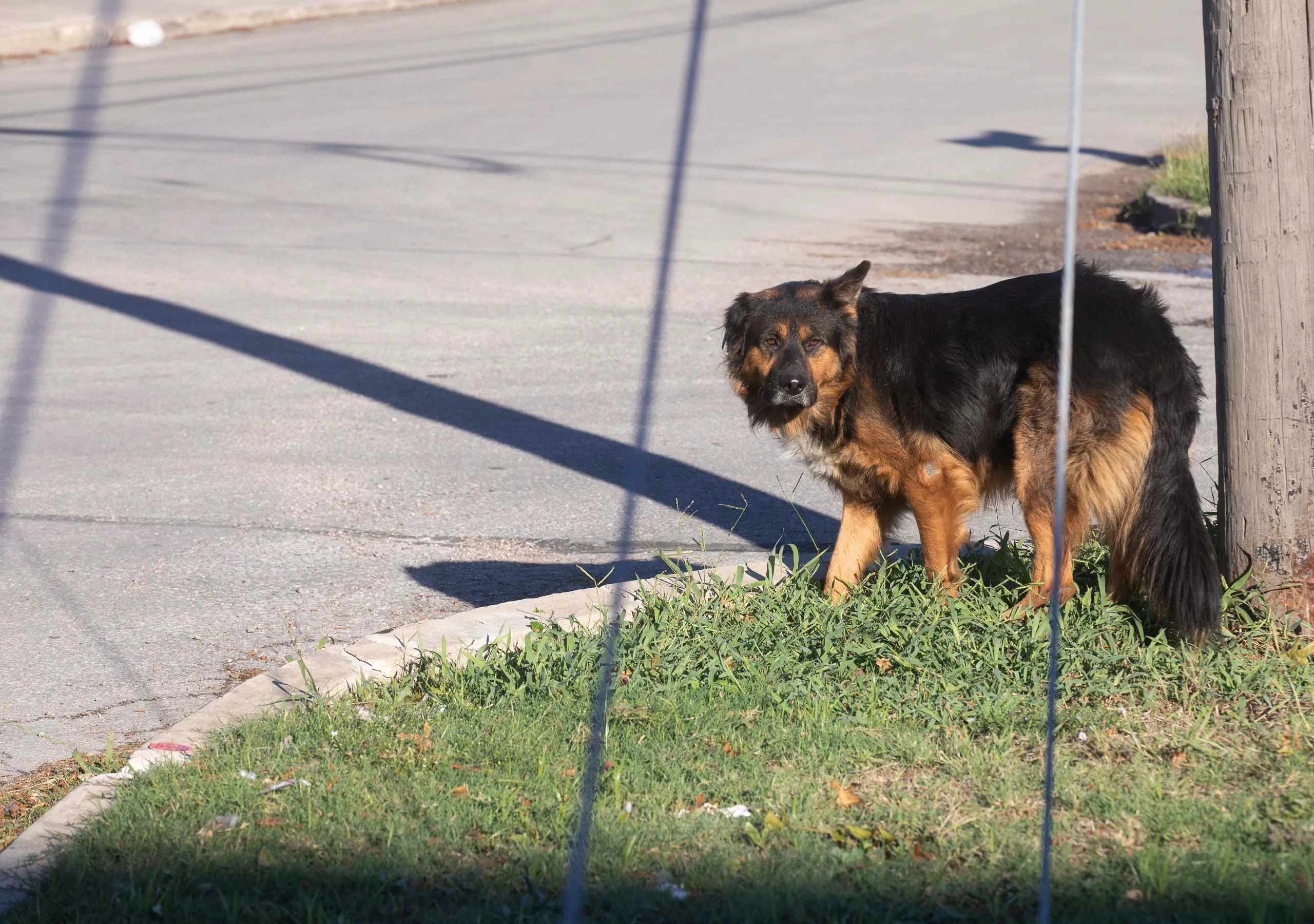
San Antonio Animal Care Services says the city’s roaming dog problem is improving, but city officials acknowledged that limited staffing and shelter capacity still prevent the department from responding to every loose dog reported by residents.
Read more More arts and cultural spaces will boost economic development, leaders say at State of the Eastside
During a Public Safety Committee briefing Thursday, ACS officials highlighted declines in roaming dog calls, aggressive dog reports and shelter intake that suggest there’s been improvement. Additional data presented to the department’s advisory board last week provided further context on how the city is measuring progress.
According to the analysis, roaming or stray dog calls for service are down 9.3%, stray dog intakes are down 14.1% and aggressive dog calls have fallen 18.1%.
Aggressive dog calls have decreased 10.1% through April compared with the same period last year, while the department’s critical call response rate has risen to 93.6% from 82.4%.
ACS Director Jon Gary said all of these factors combined indicate that there are fewer stray and roaming dogs in the community, while acknowledging that that may not be the reality most residents see.
“We fully recognize that we still have a huge free roaming dog issue here in San Antonio,” Gary said. “I think what this data does tell us, though, is that it is improving, and so that’s the good takeaway, but we are still very much dedicated to public safety and to continue to work in the community.”
At the same time the department adjusted how it calculates shelter intakes, which has resulted in a reduction in overall shelter intake by 7.7% compared to the same period in fiscal year 2025, with dog intake declining by 11.3%.
Previously, animals assisted through diversion programs were counted as intake even if they never physically entered the shelter. Under the revised methodology, only animals brought onto the ACS campus are included in intake totals.
The report noted that regardless of the changes, when a true comparison is conducted across years, shelter and stray intake are still down for the fiscal year.
At Thursday’s public safety committee meeting, an abbreviated data set was presented to council members, who largely welcomed the improved metrics but questioned whether residents were experiencing the same progress reflected in the data.
Council members repeatedly returned to a central concern: loose dogs are still being reported across the city, yet not every call results in an officer response.
Gary told the committee that ACS prioritizes critical public safety calls, including aggressive dogs, bites and cruelty investigations. Because of staffing and capacity constraints, not all stray dog calls receive a response.
“When we don’t have kennel space to bring an animal in, and that animal is not sick, injured, or posing a public safety threat. We’re not bringing them in every time,” he said.
Instead that data is collected and used to identify problem areas through heat maps and guide enforcement and outreach efforts.
“We have a sweeps team that actually will go into those areas of high-call volume,” Gary said. “Those are particularly just someone called in and said, ‘I just saw a roaming dog.’ It’s not a dog attacking anyone, in those instances we respond. Our response is determined by the complaint that we receive.”
The department’s six-member “Foxtrot” sweeps team focuses on areas identified through that data. From Oct. 15 to May 15, the team had responded to 3,756 calls for service, impounded 1,040 animals and issued 400 citations.
Through the first seven months of fiscal year, ACS investigators worked 348 dangerous dog cases, including 88 dogs deemed dangerous, 68 deemed aggressive and 22 cases in which serious bodily injury occurred. The city currently has 207 dogs listed on its dangerous dog registry.
Read more Bexar County is negotiating a $15M tax incentive package for H-E-B expansion
ACS also reported working 317 bite cases during April alone.
District 2 Councilman Jalen McKee-Rodriguez pushed ACS officials to identify what resources would be needed to address those lower-level calls before they become dangerous dog investigations or bite cases.
“The root of the problem is much further down, and it starts at those low-level calls,” McKee-Rodriguez said. “So what is it going to take for ACS to respond to those before they become bigger issues?”
Gary said expanding responses would require more than additional animal control officers. Bringing more animals into the shelter would also require additional kennel space, medical staff and personnel dedicated to adoptions and animal placement.
McKee-Rodriguez pressed the issue noting that despite previous investment ACS had historically been underfunded and would require continued investment to meet the city’s needs.
“ACS has never had the resources that it’s needed to resolve these issues, and just a few years ago in 2021, ACS’s budget was $15 million. It’s now about $30 million,” he said. “We’re still not where we need to be.”
He called for increased advocacy from the department ahead of the upcoming budget cycle and asked officials to identify whether additional officer pay, improved retention or a second ACS facility could help improve outcomes.
“It’s unclear what we need to do to improve outcomes at ACS,” McKee-Rodriguez said.
Several council members described the issue as one of the city’s most persistent public safety challenges and questioned whether current enforcement mechanisms are effectively addressing dangerous dog cases.
The discussion followed presentations from ACS and Municipal Court officials outlining the process for dangerous dog investigations, dangerous dog compliance hearings and animal cruelty cases.
According to ACS, owners of dogs deemed dangerous must meet a series of requirements, including maintaining a secure enclosure, carrying $100,000 in liability insurance, keeping the animal microchipped and sterilized and complying with annual inspections.
Through April, ACS reported an 82% compliance rate among dangerous dog owners, slightly above the department’s 80% target.
Concerns about dangerous dogs have remained a focus for city leaders since the 2023 death of 81-year-old Ramon Najera, who was killed in a dog attack on the West Side. The incident prompted renewed attention on dangerous dog investigations, reporting requirements and owner accountability.
District 9 Councilwoman Misty Spears suggested greater public awareness could help residents better understand existing dangerous dog enforcement tools, while District 5 Councilwoman Teri Castillo raised concerns about whether victims are receiving enough guidance on how to file affidavits and track cases through the system.
Assistant City Manager David McCary said the city is working to improve transparency around animal control data and is developing a district-level dashboard that would allow council members and residents to track calls, response activity and other ACS performance metrics.
“We’re not going to look the other way,” McCary told the committee. “We’re going to continue to work it and try our best to improve it.”
Read more Where I Live: Monticello Park