At only 18 years old, Maria Muñoz could soon work as a professional firefighter after graduating from Edison High School this June.
Read more Proposed ban on Big Bend border wall fails in U.S. House funding panel
She went through Edison’s firefighting academy in the San Antonio Independent School District. The fire academy falls under Edison’s health and emergency medical services magnet program, offering a combination of work-based learning, accreditations and college credit opportunities. It’s the only program of its kind locally.
For Muñoz, the academy was way to fast-track into a career where she can “benefit others by saving lives and helping others when they’re at their lowest.”
But becoming a firefighter, whether students pick the traditional or accelerated route, can still be tricky.
“They go through a whole bunch of different programs here because there’s not like one firefighter certification,” said Jeremy Guerrero, the college, career and military readiness coordinator at Edison.
It’s a bunch of certifications stacked together.
Cadets have to pass certification tests for EMT, hazmat awareness, hazmat operations and the Texas Commission on Fire Protection. Edison students take most of the health-related courses through the school’s magnet program, arranging certification tests with corresponding agencies and covering the cost.
Edison has a comprehensive health and emergency services magnet program with certification paths for EMT, dental assistance, phlebotomy and more. The program expands almost every year, adding partnerships with local universities, emergency departments and potential employers.
Serving around 1,300 students, the campus usually gets around 300 school choice applicants every year who want to enroll in one of Edison’s various programs.
But the fire academy, which launched about 10 years ago, is only open to 20 of Edison’s most dedicated students (usually seniors) who’ve taken the preliminary classes in health and emergency response.
Edison partners with San Antonio College, which has its own fire academy, to provide a 10-month course of the ins and outs of firefighting.
Firefighting in high school
Cadets start their school days early. They get to school before everyone else, usually around 6:45 a.m.
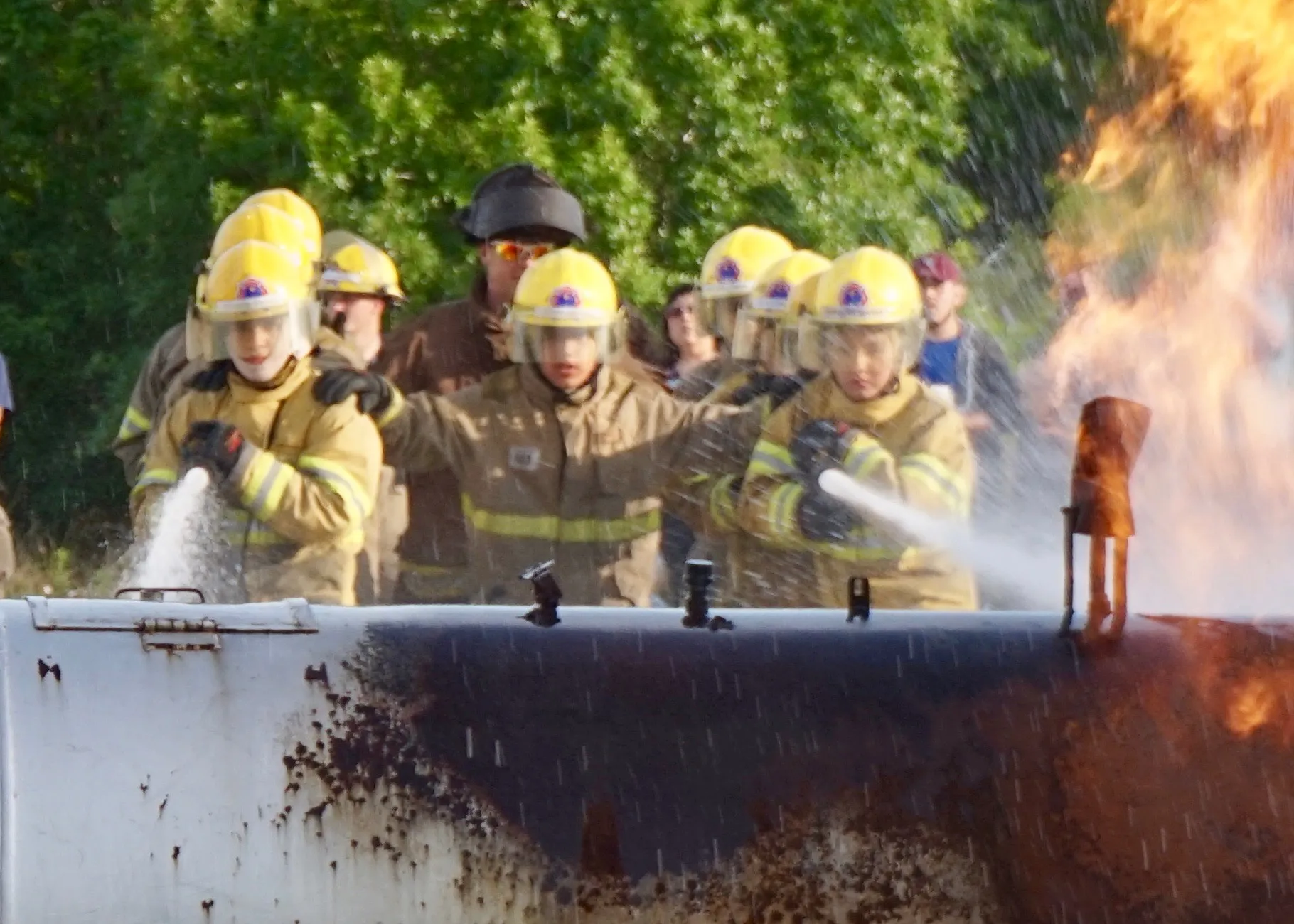
They get on a bus that takes them to the Alamo Colleges First Responders Academy on the outskirts of town, where they spend half of their day. Alongside fire cadets from the community college, Edison students learn about disaster response, fire management and fire science.
They practice putting on gear, which can weigh more than 100 pounds, and get hands-on experience managing controlled fires in the winter.
Cadets also have to meet certain physical requirements, like running a mile in less than 10 minutes, doing more than 50 consecutive push-ups and holding a plank for more than one minute.
Meeting the physical requirements may have been the easiest part for Muñoz, a decorated wrestler and cross-country runner.
“The gear you’re wearing is not just gear. It holds in sweat. It’s like a sauna, and it also carries a lot of weight,” said Muñoz.
There are also constant tests to drill cadets on emergency management and response.
Read more Pay raises at Northside ISD could be contingent on voter approval
After their half-day at the academy, cadets return to Edison for the rest of their school day: lunch, electives, and the other classes they need to finish basic high school.
“I only had two core classes this year, and my other two classes were easy,” said Muñoz, who knocked out as many credits required for high school graduation as she could ahead of her senior year, allowing her to focus more on firefighting training.
She also has some college credit under her belt.
Because of the partnership with San Antonio College, which is part of the Alamo Colleges District, most Edison cadets will graduate with a year’s worth of college credits and most of the credentials needed to become a firefighter.
It’s hard work, Muñoz said.
It’s challenging to get all the certifications by the end of high school, and some students still have to complete credits through San Antonio College or other tuition-based fire education programs.
The path to career
To get ahead of the program, Muñoz decided to get her EMT certification through Cordial Fire/EMS Education before entering her senior year, spending $800 to take a four-month course last summer.
The certification was twofold, making her a certified EMT technician and a certified CPR instructor.
She’s always been drawn toward community service, she said — most of her family works in the medical field.
While Muñoz originally wanted to be a police officer, even enrolling in Edison’s law enforcement/criminal justice program, she switched to firefighting because she thought she could help more people.
On top of the long hours and high expectations for the fire academy cadets, Muñoz said the most challenging part of the program was learning the soft skills of team work.
“No one truly understands what firefighters go through… they’re going into live fire with gear,” she said. “You have to be a team player.”
At the start of her year in the academy, fire instructors picked Muñoz as squad captain, to set an example for the rest of her squad.
“I had to keep my cadets in check,” she recalled.
While Edison’s fire academy is a lot of work, it’s also free, saving students time and thousands of dollars, ultimately shortening their path into the workforce.
In comparison, going through the Fire Academy at San Antonio College costs approximately $4,240.
At San Antonio Fire Department, a probationary firefighter makes $5,348 a month for the first 18 months on the job and gradually gets bumped up to around $6,000 a month after five years on the job.
Muñoz said she felt “lucky” to have a program like Edison’s, paying for student to get hands-on learning that “not many people do at a young age.”
Read more The dance of culinary art in the Michelin star kitchen at Mixtli
“I just want to save lives,” Muñoz said.