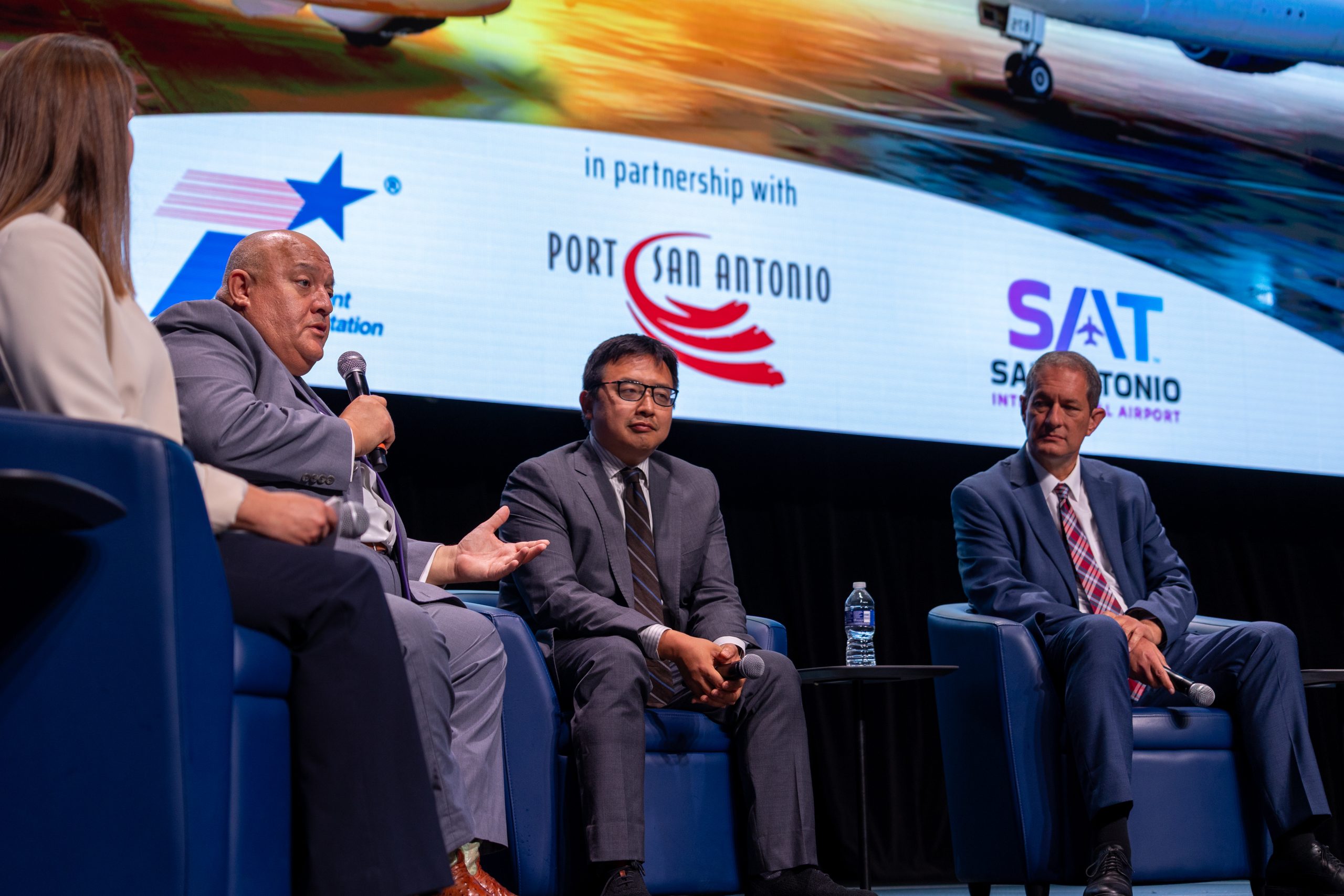
All eyes were fittingly on the skies in the hours leading up to the annual gathering of aviation and transportation industry folks on Friday.
Read more A nationwide liquor distributor is selling its Texas operations, affecting 372 local workers
As a line of spring storms rolled into the area during the annual State of Aviation event, thunder punctuated a declaration by state and local leaders that modern aviation is entering a bright new era, and San Antonio is at the forefront.
“We are witnessing the emergence of electric propulsion, powerlift aircraft, autonomy and distributed operations, and new cases for the use of aviation and aircraft that we’ve ever done before,” said Dan Harmon, director of aviation at the Texas Department of Transportation.
“If history is any guide, San Antonio won’t just be a part of that next step in aviation,” he added. “San Antonio will be helping to lead that next step in aviation. You will help define this new definition of mobility.”
New industry partnerships and federal projects are positioning the tech and innovation campus Port San Antonio for that next step.
Urban air taxis, electric vertical takeoffs and landings and new air navigation systems are not the stuff of science fiction according to panelists at the San Antonio Mobility Coalition’s recent event.
The Port recently signed on to a partnership with Austin-based SkyGrid to provide a real-world testing environment for autonomous aircraft systems in complex, low-altitude environments.
A Boeing company and subsidiary of Wisk, SkyGrid is developing the digital infrastructure needed to safely integrate next-generation and autonomous aircraft into shared airspace.
“Everything starts with the airspace, particularly as we want to integrate increasingly autonomous air traffic into the airspace,” said SkyGrid CEO Jia Xu. “Our very mission is to open up the airspace for increasingly autonomous aircraft and also automated air traffic management systems.”
Planning for autonomous aircraft flying through the skies at low altitude presents different challenges than for autonomous vehicles on the road, Xu said.
Figuring out how to make that work has applications for the entire aviation industry — advancing it beyond a reliance on only visual and instrument navigation systems.
“It is my hope that someday our systems will contribute to the overall safety of the national airspace when we apply responsible automation as a layer to the natural airspace,” Xu said.
Port San Antonio CEO Jim Perschbach said the innovation campus is ideal for the project because it provides a variety of topography, weather and airspace conditions.
Read more Middle East oil slows down, Venezuelan oil flows in and Valero shows strong returns
More than $37 million in FAA-supported infrastructure investments are underway at the Port, alongside Kelly Field. The work is intended to support future advanced air mobility capabilities — including a planned vertiport.
The Port is also part of a Federal Aviation Administration (FAA) pilot program to be administered by TxDOT to research the integration of advanced air mobility and electric vertical takeoff and landing (eVTOL) aircraft, and is a member of the FAA’s Center for Advanced Aviation Technologies, managed by Texas A&M.
CAAT focuses on the testing and integration of new and emerging aviation technologies, including urban air taxis, short takeoff and landing aircraft, cargo and logistics networks, emergency medical response operations and autonomous flight technologies.
A statement from the Department of Transportation said the American public will start to see operations begin under the CAAT program in the coming months.
Those air mobility projects also are behind the Port’s drive to acquire from the Air Force the runways at Kelly Field, Perschbach said.
“If we do that, that opens up something that nobody else in the world has, which is the ability to have a full international civilian and military airport where you can stand up [authorizations and agreements] and the right type of test environments,” he said.
In the meantime, while the San Antonio International Airport is undergoing major transformation and modernization, the Port is also promoting its efforts at expanding air service facilities and capabilities.
Design work is said to be underway on a 40,000-square-foot vertiport terminal, a launching pad for electric planes that take off and land vertically, a concept the Port has floated since at least 2022.
The urban air taxi concept could go a long way to solving infrastructure problems in the nation, Perschbach said, including in the planned sports and entertainment district in downtown San Antonio.
“From a developer standpoint, every time you have to build a new parking structure here on the campus, it’s $20 [million], $40 million really, non-revenue generating space,” he said.
“If you can better manage that airspace, what you can do is you can bring aircraft in that essentially functions as an augmentation of the municipal transportation system. They may look like flying buses, but imagine that,” he said.
Clarification: This story has been updated to clarify SkyGrid’s partnership with Port SA and how it works with the Center for Advanced Aviation Technologies.
Read more San Antonio arts commission OKs mural for expanded airport terminal