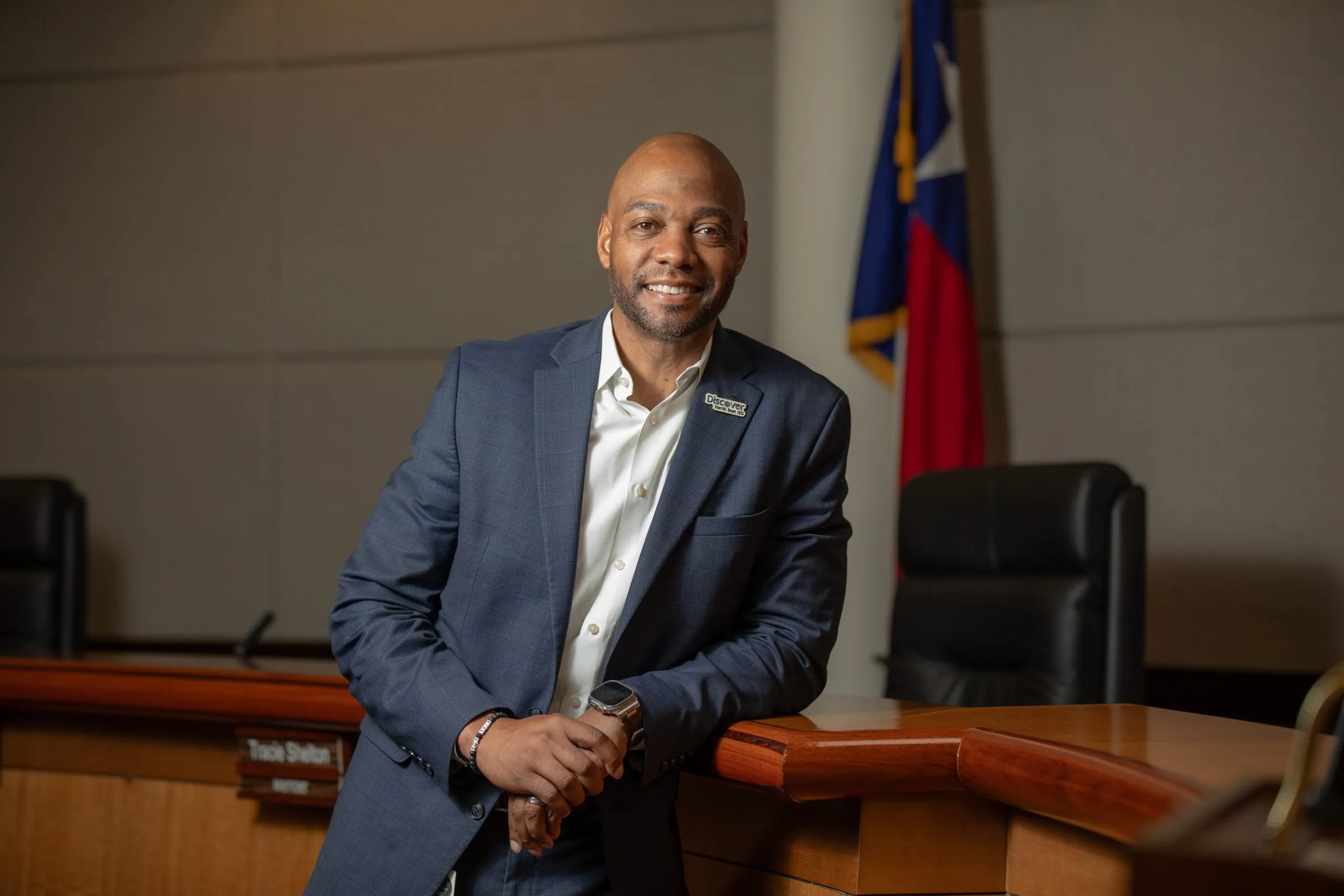
Anthony Jarrett didn’t set out to be superintendent of San Antonio’s second-largest school district when he started his education career.
Read more Ted Cruz bill to regulate college sports in NIL era advances
In fact, he didn’t plan to work in education.
After moving from the Chicago area to Texas in his teens, Jarrett studied psychology at Texas Tech University, later working as a counselor in a San Antonio mental health facility for over five years. So how did he end up leading North East Independent School District and serving 55,000 students across 65 campuses?
“I started seeing patterns,” Jarrett recalled his time as a counselor. “I just started thinking to myself, you know, do I spend all my time trying to fix the problem, or maybe I enter a field where I can prevent the problem.”
So he left counseling, got a teaching certificate and began his education career as a high school teacher in Northside ISD, rising through the ranks as assistant principal, vice principal and principal, putting his counseling background to use.
Jarrett eventually moved up to NISD leadership as executive director for secondary curriculum and instruction. That’s when he got an inkling that he could be suited for a bigger role.
“I had a lot of experience in high school, that’s all I knew. But I said to myself, if I ever want to be a superintendent, I want to make sure that I understand ages pre-K through 13,” he said.
So he left NISD in 2019 for a role at North East ISD as chief instructional officer, where he could reach all grade levels.
When NEISD’s then-superintendent left in January, the school board chose Jarrett as interim, before naming him as the sole finalist for superintendent in May and finalizing his appointment on June 16.
Now officially in the driver’s seat, Jarrett’s job will be to lead the district through a budget deficit, declining enrollment, a growing school-choice movement and uncertainty about the way the state’s new education savings accounts — state dollars for private school tuition and education services — will affect public schools.
Jarrett sat down with the San Antonio Report to talk about his vision for NEISD in a shifting education landscape.
This interview has been edited for length and clarity.
What do you view as NEISD’s biggest challenges right now? What about opportunities?
One of the challenges we have is enrollment. This past year we lost over 1,000 kiddos that we thought were going to be in our schools. You hire staff based on your projections over time, and you expect to lose some kids because the projections tell you that. This year exceeded what we typically would see in our loss of enrollment, but our teachers had already signed a contract, and what that does is it holds us accountable to still have to keep staff on the payroll, which then creates a greater deficit
This coming year we have an even bigger challenge, because we have a new variable that’s in play, and that’s education savings accounts. We still have to adopt a budget based on our projections without that variable in place. The state did not put us in a position to hold us harmless for a year, for us to get new numbers and new projections based on this new normal. I don’t make excuses. I think families need to make the choices best for their family. I firmly believe that that is a parent’s decision. My challenge is, I don’t believe we should be pitting each other against each other.
Read more Alamo Colleges District seeks approval for city’s first land surveying certificate program
Last year, the district closed three schools to save money. What can we expect from NEISD in the future to deal with deficit and having fewer students ?
The first thing we did was try to put our heads together and ask the question: how can we increase enrollment? So we opened our boundaries. We also are expanding our career tech and technical education programming department. Our hope is that more people see us as a viable option, and then we’re maybe not having the conversation about consolidating or closing schools.
However, if our enrollment continues to decrease, we’re going to have to revisit that conversation, especially in schools with fewer than 450 students, using less than 60% of the building capacity, where it’s costing five times above the average to educate a child. If a school meets all three of those, then those would be the ones that we would be reviewing and considering. But I don’t want to make a premature decision before we have all the numbers in the fall.
Given the moment we’re in, I have to ask about artificial intelligence. How is NEISD using it, and what role do you think it plays in education?
I would go very slow. AI may have a place in education, and I use the word “may” because we haven’t discovered how it can be used. We’ve created a playbook to help our staff know how to use AI effectively and efficiently, but we’re reviewing and adjusting as it continues to evolve, and I think it’s irresponsible for us not to continue to question how it can be an advantage or disadvantage to our schools and our classrooms.
What’s so important in education is affording the kids a productive struggle to think independently, to apply new knowledge in a meaningful way. How can we get to the point where they’re truly growing academically and intellectually if they’re not thinking independently? I’m not saying that AI would completely prevent it, it’s just how we implement it the right way that matters.
The last state legislative session resulted in miles of education policy that school districts are still implementing, and the next session starts in January. What education issues should lawmakers focus on?
I think AI definitely is something that the state is going to have to put some regulations in place.
I also think the Legislature should revisit the funding formula. In this last legislative session there were very clear dollars outlined and delivered to teachers only, and I agree wholeheartedly. Teachers should be paid because they’re at the forefront of educating kids, but a school system as a whole does not function just in the classroom alone. I would like them to perhaps not be so rigid. School districts need some flexibility in how they leverage their dollars.
I hope they revisit the budget funding of public education. I mean, I know they put a lot of energy into the ESAs. I would just hope to see them put as much energy into public education funding as well.
What about some of the more sensitive laws that passed, like the parents’ rights Senate Bill 12, and the different bills targeting libraries and book lists? Tell me about implementation at NEISD.
We were already having conversations early on with our communities. Unfortunately, school systems are thrust right into the middle of these types of social issues. I think at this point, we have adjusted accordingly. We maintain the choice in our libraries and flexibility, but we also give the parents the opportunity to see inside their kiddos’ reading selections.
The school-based health services piece (in SB 12) did give me pause, because we don’t know what we don’t know. In the case of a crisis, we want our staff to make the right choice. My concern, whenever you create a policy like that, is fear going to stop them making the right choice?
NEISD isn’t unique in going through leadership changes right now. Superintendents in San Antonio’s largest district are retiring or stepping down. As someone who’s now in that seat, what do you think is going on?
Only an individual can know why they make a decision to leave a position and do something different or walk away completely. Do I think the stress level of this job can get to a person? Absolutely. You’re caring for over 50,000 kiddos and their families and over 6,000 employees
It’s like running a marathon. Eventually, you have to get to the end, and the end is full of exhaustion, but also gratitude. I think all those folks that are stepping down, I think perhaps they ran their marathon and they got to the end of their race, but I guarantee you they’re looking back and they’re saying it was worth every minute.
Public education has changed immensely, and it probably will never be the same. And so sometimes you make a choice to move on, because the movie that you first entered is not the same movie that we’re in.
Read more Top 5 races to watch this November 2026 election
READ MORE
Alamo Colleges District seeks approval for city’s first land surveying certificate program
by Danya Pérez
Texas A&M University-San Antonio’s first doctoral program now accepting applications
by Danya Pérez