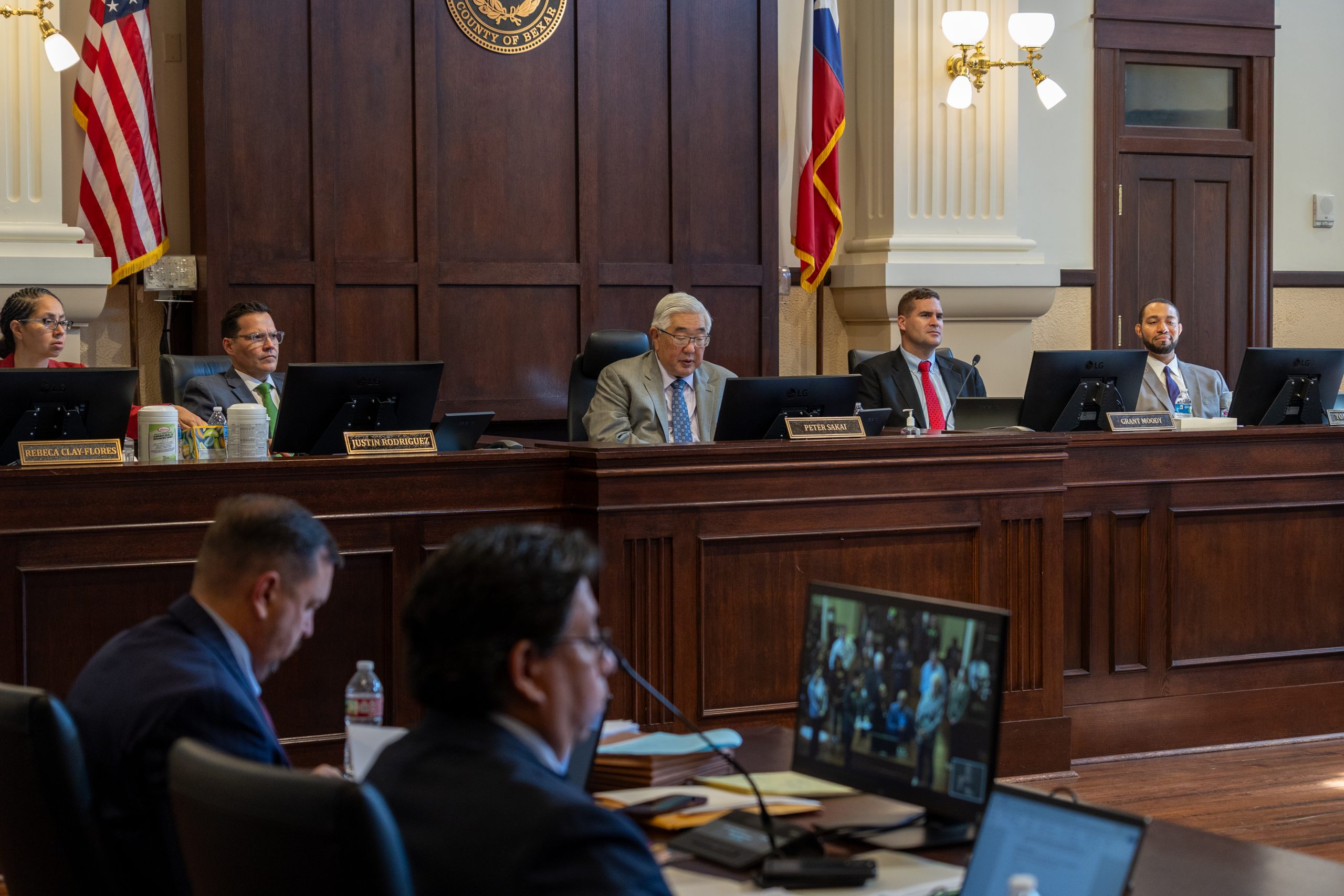
As Bexar County braces for what officials have warned could be one of its most difficult budget cycles in decades, a debate over buying two police motorcycles offered an early look at how county leaders may approach looming financial challenges.
Read more Heavy rain hits San Antonio area as Flood Watch remains in effect through Tuesday evening
The discussion unfolded last Tuesday when Precinct 3 Constable Mark Vojvodich asked commissioners to approve the use of roughly $114,650 in unexpended salary funds to purchase two BMW police motorcycles and related equipment.
The funding was not a request for new county dollars. Instead, Vojvodich proposed using salary savings that accumulated when budgeted positions sat vacant during the current fiscal year. Those funds are already allocated within the constable’s budget and would otherwise revert to the county’s general fund at the end of the fiscal year.
But the debate quickly shifted beyond the purchase itself.
As county leaders prepare for a budget cycle expected to be shaped by slowing property tax growth and projected future shortfalls, commissioners sparred over whether the motorcycles’ potential revenue benefits should factor into county decision-making.
Vojvodich argued the motorcycles would allow deputies to conduct traffic enforcement more efficiently, increasing the number of contacts officers make and generating additional traffic-related revenue.
According to projections included in the proposal, a motorcycle officer averages about 2,661 contacts annually compared with 1,625 for a deputy operating from a Chevy Tahoe patrol vehicle.
The constable’s office estimated a motorcycle unit would generate about $254,000 in traffic-related revenue during its first year compared with roughly $155,000 for a Tahoe unit. Over five years, the office projected the gap would grow to roughly $1.27 million versus $776,000.
“The financial return again for motorcycles, is a responsible investment,” Vojvodich told commissioners. “Traffic enforcement generates revenue through legislatively authorized fines and fees, offsetting taxpayer funds.”
Precinct 4 Commissioner Tommy Calvert and Precinct 3 Commissioner Grant Moody ultimately supported the proposal, arguing county leaders should give elected law enforcement officials greater latitude to manage their own operations and consider opportunities to reduce future taxpayer costs.
But County Judge Peter Sakai, Precinct 2 Commissioner Justin Rodriguez and Precinct 1 Commissioner Rebeca Clay-Flores raised concerns ranging from liability and long-term costs to whether the request should instead be considered as part of the county’s upcoming budget process.
Against that backdrop, Calvert framed the proposal as part of a larger conversation about how local governments respond to financial pressure, suggesting county leaders should be open to unconventional ideas as budget challenges mount.
“In an environment where thousands of dollars, tens of thousands and millions of dollars matter for revenue,” Calvert told the constable. “You’ve done us a favor in providing us a potential revenue source.”
Calvert said governments facing financial pressure often concentrate on reducing spending while overlooking opportunities to generate additional revenue through existing programs and assets.
“Most governments in austere budget-tightening environments just look at cuts,” Calvert said. “But I also think that government can innovate.”
He pointed to examples discussed through the National Association of Counties, including governments leasing public assets for cell towers or selling advertising on buses to generate additional revenue.
“There are some folks … who were facing a tremendous budget deficit and instead of going to austerity, what they did was look at all of their assets,” Calvert said. “And they asked, how do we maximize our assets?”
Read more How some San Antonio students go straight out of high school and into the fire station
Calvert also cautioned against dismissing proposals simply because they depart from existing practices, arguing that departments with direct operational experience may identify opportunities that are not apparent through the traditional budget process.
Sakai, however, rejected the idea that traffic enforcement should be viewed through a revenue lens.
“I will oppose a policy of revenue based on traffic enforcement,” Sakai said. “We have issues in regards to disproportionality in regards to that issue and the burden it puts on people that least can afford it.”
Sakai said public interest groups have repeatedly raised concerns about fines, warrant enforcement and court fees affecting vulnerable populations.
But Vojvodich argued the revenue generated through traffic enforcement is not a new funding strategy for the county.
According to a financial analysis presented to commissioners, Precinct 3 historically relied on a combination of civil process fees, warrant fees and traffic-related revenue authorized under state law to offset operational costs.
The analysis showed taxpayer support accounted for roughly 4% of the office’s operating costs in fiscal year 2014 and about 1% in fiscal year 2015, when the precinct maintained dedicated traffic enforcement positions.
After county staffing reductions eliminated those positions, the taxpayer-funded share of the office’s operating costs rose to 38% in fiscal year 2016 and now sits at 30% in fiscal year 2026, according to the presentation.
In a follow-up interview, Vojvodich said the proposal was less about generating new revenue than restoring a funding model that historically reduced the office’s reliance on county tax dollars and subsequently relieved financial burden on the county.
“We’re just trying to reduce that taxpayer burden,” he said. “We’re probably one of the few county agencies that are able to do that.”
The disagreement comes as both Bexar County and the City of San Antonio prepare budgets amid slowing property tax growth and mounting financial pressure.
Earlier this year, county officials warned commissioners that Bexar County could face a $148 million gap between projected revenue and expenditures by fiscal year 2028 if current trends continue.
At the city level, officials last year approved increases to parking fines, alarm permit fees and other charges to help balance the budget without raising the property tax rate. City leaders are now also considering a property tax rate increase and utility rate hikes as they prepare next year’s spending plan.
While the motorcycle proposal represented only a small expenditure within the county’s $2.8 billion budget, the debate exposed a larger divide over how county leaders should respond to mounting fiscal pressure.
The proposal failed on a 3-2 vote, with commissioners indicating they would be more comfortable considering such requests as part of the county’s broader budget process later this summer.
Read more Proposed ban on Big Bend border wall fails in U.S. House funding panel